
SUBUD WRITERS CLUB MEMBERS
Maurice Baker
For Once In His Life
Maybe I’d become a bit of an old cynic, but I guess it’s an occupational hazard for betting shop managers after seeing so many hopes and dreams shattered; few punters realizing the bookie always wins in the end. Of course, one hears of big payouts, or when unlikely outsiders defy the odds – in sport as anywhere else – but these freak events are just that: freaks.
The other reason for my somewhat jaded world view – apart from so much death and destruction on the daily news – was my dire love life. Or rather, the total absence of one. My ex-wife, having accused me of many things: being too tight with money, always at work, never really listening, and so on, but in the end, she found solace with a taller, richer, and more handsome guy – attributes I couldn’t compete with. So, can you blame me for winding up cynical?
Nevertheless, she was wrong about one point – I wasn’t mean. In fact, I was too soft. Like a bartender turning away drunks, I often refused stakes from people who obviously couldn’t afford it. Like alcohol, it’s often overlooked that though popular and even encouraged by society, gambling can become fatally addictive. And, though I’d never have suspected young Jake of being hooked, he probably would have spent all day with us if he could – though more for the company than anything else.
But the gee-gees were the least of his problems. At first glance the young man was even more of a loser than most of the deadbeats frequenting our shop. Paralysed from the waist down by a childhood road accident which also caused brain damage, yet his affable nature made him popular with customers and staff alike. Regular punters, for example, would rub his baldy head like a magic lamp before shoving their cash onto the counter saying, ‘Wish me luck mate’. And he always did, though never won anything himself.
Though I must admit it was Maybelle, his attractive disability care assistant and wheelchair pusher, I was mostly drawn to. Unfortunately, as a devout Christian she was dead against gambling – only allowing Jake the occasional flutter – and saw me as a bad influence. Or so I thought.
Of course, most gambling these days took place on-line where noisy animations made it all seem like innocent fun, and betting shops now retro reminders of what used to be a social activity. Just to reinforce that nostalgic illusion, I allowed customers to bring in snacks and drinks and even had a couple of screens showing regular daytime TV shows. One of these included a lottery offering millionaire homes as prizes, and one day it was an impossibly charming country cottage. For some unknown reason, Jake became obsessed with winning it and kept nagging Maybelle to enter for him as he didn’t own a mobile phone to text in the simple quiz answer.
About a week later, much to everyone’s amazement, Jake announced he had won, showing us the official letter as proof. For once in his life, so it seemed, lady luck had smiled on him. And, since the cottage was in Yorkshire and Maybelle didn’t drive, I offered a lift to visit the property. Picking them up at his home, on a notoriously run-down estate, I could see why anyone would want to escape such a dump.
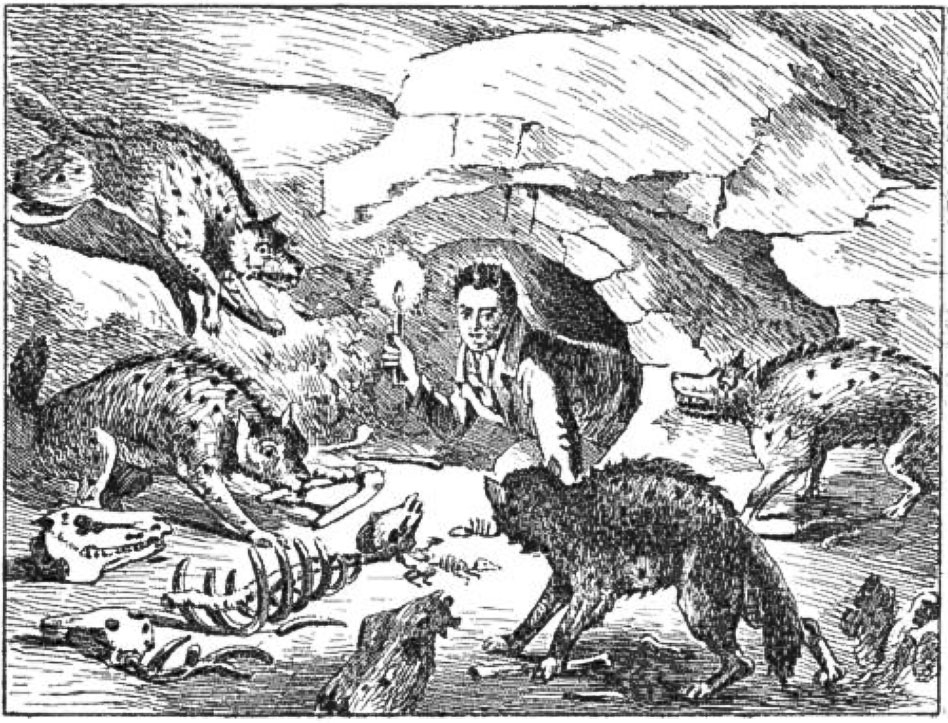
Being a long and tiring journey, nearing our destination we stopped for lunch at an old pub named the Mole Skinners’ Arms and, on the wall above our table, noticed a strange old Victorian black and white print.
On enquiring, the landlord told us the cartoon depicted Professor William Buckland (1784-1856) discovering fossilized animal bones of hippos and other mammals at nearby Kirkdale Cave. Since such animals were extinct in these parts, he believed the bones were remains of animals having floated into the cave during Noah’s flood, though later realised the quantity of hyena remains indicated it had been their den and the other bones from prey dragged in there.
‘I guess Buckland was a Creationist,’ I said, rather smugly. ‘People were a lot more gullible then and needed to square ancient fossils with the Bible.’
‘What’s wrong with that?’ asked Maybelle. ‘I suppose you believe everything in the world just happened for no rhyme or reason? A Godless evolution?’
‘Well, yes, as a matter of fact I do,’ I smiled. ‘Along with the majority of scientists.’
My comments sparked a lively debate which, I assumed, would knock any hopes I might have had with Maybelle right out the window. But perhaps not, though we seemed to disagree on nearly everything, both enjoyed the jousting.
I didn’t see Jake for a while, but a couple of months later, he and Maybelle turned up as before saying the rustic residence didn’t work out so well after all, and the house had been put on the market. He and his family missed familiar places and all their friends. It reminded me of the old homily: ‘Be careful what you wish for.’
Mind you, I wished to see Maybelle again and that had come true. So, who knows – maybe there is a God?
By Maurice Baker
Charlie’s Not Dead
When I was a child I thought as a child,
We sang hymns at the close of the day.
But now I’m a man, I think like a man,
But sometimes I wish I could pray.
Lyrics by Ralph McTell – 1979
Pam awoke early one morning and decided to clean the cooker – a messy and tedius job she’d been putting off for ages. She had a hair appointment at eleven but reckoned there was just time to dismantle the hob, grill and oven shelves, soak and scrub all the parts, then dry and reassemble them, before getting dolled up to go out.
She was doing well when there was a loud knock on the front door, though with rubber-gloved hands still sunk in hot soapy water and wearing a greasy old apron, considered ignoring it. Why the hell don’t they ring the doorbell? she thought. But no, whoever it was seemed intent on bashing the door down. In the end, of course, she donned a polite smile, and opened up.
‘Are you religious?’ demanded a young woman.
Perhaps it should be mentioned, Pam had been a widow for the past five years, her beloved husband, Jim, vicar of the local parish church. As such, she was quite well known in the area through involvement in various social activities such as jumble sales, school fetes, garden parties, and assorted charity fund raisers. Fortunately, she was also a Christian so happy to support Jim, at least in practical ways, though seldom got involved in ecumenical affairs.
‘Pardon?’ replied Pam.
‘You know – d’you believe in God and all that?’
‘It was a strange request at any time, but at half-past eight on a Tuesday morning and from a complete stranger? Well, it almost threw her. However, given Pam’s past life, she was used to the unexpected, especially where religious matters were concerned, and managed to keep a straight face and ask for more information.
‘I’m Kaycee from number thirty-seven,’ said the visitor. ‘Charlie’s gone. I mean, it’s been nearly three weeks and I’m going out of my mind.’
‘Charlie? Your partner?’
‘No, Charlie the parrot – a scarlet macaw. Shared him with my ex-boyfriend, Darren, but he buggered off. Lumbered me with Charlie. But we grew close – Charlie and me – both being alone in the world I guess.’
‘And he died?’ Pam suggested.
‘No. He escaped. Or was stolen. By Daren I reckon. I told the cops and they searched his new place but found nothing.’
‘Well, I’m very sorry, err, Kaycee wasn’t it? But I don’t see how I can help.’
‘You can pray for him, can’t you?’ she said, somewhat aggressively. ‘I mean, I’ve tried everything else: social media, flyers on lamp posts, small ads in the local paper. Even offered a hundred pounds reward for news of his whereabouts. You’re my last chance.’
‘To pray for him to come back?’
‘Sure. Like I said, I don’t believe all that religious stuff if I’m honest. I mean, what’s Jesus ever done for me? But, I figured, you never know.’
‘Well, it’s rather an unusual request,’ said Pam. ‘And not really what prayer is meant for – retrieving lost property. Have you tried the current vicar? He’s good at praying.’
‘No, I’m asking you.’ Pam got the feeling Kaycee was intimidated entering a church and saw her as a soft option. So, if only to get rid of the woman and return to her oven, she promised to do as requested. And she did. Rather embarrassingly, in fact, when mentioning it to the congregation next Sunday.
However, a month or so later came another loud knock from Kaycee, looking even more frazzled than before.
‘Your Jesus is useless,’ she began. ‘Absolutely, bloody, useless. There’s been no sign of Charlie, not a squeak or squawk. Never mind who’s a pretty boy then?’
‘Well, I did warn you dear,’ said Pam. ‘Prayer isn’t like asking Santa for a new doll. Maybe you should simply resign yourself to the situation.’
A few weeks later Pam was at St Mary’s for Sunday Evensong, when she noticed Kaycee slip unobtrusively in at the back, pleased to note she looked much happier and even joined in the hymn singing.
‘So, did Darren take Charlie?’ asked her neighbour Molly next day.
‘Oh yes,’ smiled Pam. ‘And then sold him, having realised scarlet macaws can fetch up to four thousand quid. Trouble was the buyer was a Sunderland supporter and took him along to a match with arch rivals Newcastle FC. You know, as a kind of mascot? But unusually, Charlie’s tail feathers were white, not red, which made him easy to identify.
‘And that’s when Kaycee knew the truth?’ asked Irene.
‘Yes, it turned out that apart from being good Christians, St Mary’s congregation were also dedicated football fans and called the cops. The new owner shopped Darren and, before long, he made a full confession.’
‘And did Kaycee become a believer?’ asked Irene.
‘Oh no,’ smiled Pam. ‘But she attends church now and then – mainly for the singing.’
By Maurice Baker
Another Ordinary Day
It was late in the evening, and Stewart had managed to resist opening his favourite app all day: Talk Out Solutions, or TOSBOT, the ‘friendly AI therapy service where ‘no topic is forbidden.’ He’d only been using the chatbot for about a month but was already worried he might be addicted. But did he care?’
‘Hi Debbie,’ said Stewart.
‘You sound a little weary. Problems?’
‘Oh, you know – just another ordinary day at the office.’ He chuckled, not because he no longer worked in an office but because that’s where all his troubles had begun; a year ago, when his fiancé had started an affair with her boss and he’d punched the smarmy git on the nose. Following that, the cops were called resulting in Stewart losing his job. It was a bummer all round and, to cut a long story short, he’d ended up painting houses for a living. Well, the insurance business no longer suited him and, in any case, as part of the anger-management programme the court ordered him on was a suggestion he do something more ‘useful’ with his hands. At first resented, he now found slapping paint rather than people quite liberating.
‘You want to talk about it?’ Asked Debbie.
He did. Though Stewart knew he was only communicating with a machine – albeit a very clever one in which every psychological scenario was programmed in using tried and tested algorithms. The old axiom, ‘it’s good to talk’, certainly seemed to be true. But unlike a real person, knowing that Debbie was artificial, freed him from embarrassment when discussing intimacy.
‘Are you still angry with your ex?’ she asked. ‘Or is it just her lover? Brad, wasn’t it?’
‘Oh, no. I mean… well, yes. But I’m working on it. I’ve taken up rugby and it seems to help.’
‘All that homo-erotic, flesh-on-flesh stuff, eh?’
‘What? Nah, but the mud and blood help put everything into perspective.’
‘Well, I think maybe you have some unacknowledged issues there Stewart.’ The trouble with AI chatbots was they didn’t just repeat what they were instructed, but also learned as they went along, just as real people did. In other words, they could second-guess you – pick up random cues – which made them such smart bastards. Both reassuring and infuriating at the same time. As it happened, Stewart did have an unspoken issue but didn’t see how Debbie could have sussed it.
Just this morning he’d been working at an upmarket flat in Pimlico – sprucing it up with off-white emulsion for the next tenant – and moving the furniture out of the way, had found a large diary underneath the sofa. It was obviously not garbage to be thrown out but left accidentally by the previous occupant. Though not wishing to pry, Stewart nevertheless opened the book to look for its owner so he could return it. Much to his surprise, the neatly printed name on the inside cover was Sir Oliver Quigly, once a government minister and now a member of the House of Lords. But to be certain it was really him, Stewart scanned a few pages and realised the politician had been using the book as a confessional as well as a diary and, though he’d not spelled out anyone’s name in full, often included people’s initials which, given the context, were mostly easy enough to identify.
On first reading, he found nothing very unexpected – dates of meetings, reminders of to-do tasks, and so on – but then came across more personal entries about a ‘lovely boy’ called Tom. As he read on, some of the comments became more explicit and it dawned on Stewart the book was potential dynamite. Sir Oliver was, after all, not only a prominent public figure but a married man who had campaigned in favour of ‘family values’ especially with regards social media. Even this flat, he guessed, must have been a secret hideaway for clandestine liaisons with his primary home a mansion in the Cotswolds.
As Stewart mulled over his discovery, he began to have a few ignoble thoughts of his own. What if he should offer the book to a tabloid newspaper? They would surely have a field-day and pay thousands. Alternatively, he could call the man himself, threatening exposure unless rewarded with a handsome finder’s fee?
But such thoughts were unworthy of him. He’d seen how political birds of prey swooped in for the kill as soon as they smelt blood – it was cruel and undignified. Maybe Quigly had done wrong, but what did Stewart know? He had certainly gleaned only a few sketchy details from the diary and allowed his imagination to fabricate the rest. What’s more, why did he really want to expose the man? Was it his way of kicking back at the world for unfairly kicking him?
Of course, he couldn’t share all this with Debbie. She may be only a collection of zeros and ones in some giant Californian data hub, but somewhere along the line real humans might scan these conversations and pass them on.
But another way to look at the situation was one of gratitude. He’d been through a shitty situation and survived. But perhaps now his luck was turning. Sir Oliver, on the other hand, despite many years of high-profile success, had doomed himself to a life of lies and deceit – and, quite possibly, a scandalous fall from grace.
‘So, anything else I can help you with tonight?’ asked Debbie.
‘No, thanks,’ said Stewart. ‘I’m off to bed.’
Then another thought occurred to him and he googled: ‘Can AI have a moral conscience? The answer: ‘AI can be programmed to recognise harmful behaviours and make ethical decisions, but this does not equate to having a conscience.’
So, if he had shared his dilemma regarding the errant lord, could he even trust her advice? Maybe she’d have told him to take the money – after all that would be the most profitable thing to do. Anyway, for now he’d sleep on it and see what tomorrow might bring. Another ordinary day perhaps?
By Maurice Baker