
Subud Writers Club
The Subud Writers Club
Sometime in 2020, during lockdown, Lucy Houbart floated the idea of forming a Writers Club. Having had a lot of experience with local writers clubs, she knew the ropes and quickly set up a club to be run fortnightly as a Zoom meeting.
At the time of writing we’re still going strong with a core membership of three members (myself, Lucy Houbart and Maurice Baker) who’ve been there since the beginning, and another eight who’ve joined at different times – David McCormack, Renata Fitzpatrick, Alexandra Martin, Grahame Pitts, Tasneem Samuels, Renee Santosa, Maxwell Saxty and Harris Smart. There have been maybe twenty other members since 2020, who have had to drop out for personal reasons.
Members are currently from England, Ireland, the United States and Australia (and also in the past from Belgium and Canada), and this is why, because of global time zones, we set the meeting time as 1.30pm GMT on a Tuesday, usually fortnightly, but over holiday periods, Christmas and the New Year, this can stretch to 3 weeks, or a even a month apart.
Lucy set the agenda for the meetings as follows. A Chair is chosen, or volunteers, at the end of each session. The new Chair then sends a ‘prompt’ (i.e. a title or topic) a few days later to all members in an email, setting a word limit plus a request to send the piece to him/her by a certain date. The Chair then collates the pieces in the order they arrive and sends out again unnamed to all members a day before the next meet, but we do get used to one another’s writing style so can easily recognise who did what.
At the meeting, each member reads their own piece and after, comments and discussion are invited. Any criticism is usually creative, helpful, and mostly encouraging as individual’s strengths and weaknesses are revealed over time. The sessions tend to last about 2 hours and are lively and a lot of fun, but sometimes serious, touching on more in depth themes.
The prompt is to be interpreted as one feels fit and can be in any format or genre – a poem, a short story, a play, an article and so on.
If you’d like to read our pieces, please follow the link below and you can read our latest compilation of pieces. If you’d like to comment on any, please send to houbartlucy@gmail.com and she will pass it onto the author of the piece you have commented on.
Marcus Bolt.
WRITERS CLUB 24th February COMPILATION
Don’t Panic (1)
‘What about an ice cream?’
‘Sounds great except there isn’t anywhere to get one on this beach’.
‘No, but there is one on the main beach’.
‘I’m not walking all the way over there, its miles up over the headland’
‘We’ll take the canoe and paddle out round past the harbour. Look you can see the other beach and there is that truck thing they bring down onto the sand. They have great ice creams and organic too’. They both peer at the distant beech which seems to be shimmering in the heat, although in the distance they can hear the rumble of thunder and see the beginnings of clouds on the horizon.
‘What are you two thinking about’ Joe asks looking up from building castles with the kids
‘Just a little adventure’.
‘Yea’ I join in ‘An old age pensioners adventure, come on Sue let’s go’ I reply
‘Woo you two, we ought to pump up the canoe a bit, we haven’t checked it over in days.
‘It’ll be fine’ I say. ‘And no we don’t need the life jackets we’re only going just over there’.
‘Go Nanny Pops go’. The grandchildren trot over and they begin to chant. Sue (Nanny) and Pops (me) do a mock bow, gather up the paddles and haul the canoe over the sand and into the shallows. There, with the canoe just beginning to float in the water, there is an intense conversation about types of lollies we’ll buy, the adults agreeing that it will be impossible to bring back actual ice cream, so we carefully confirm their favourite lollies.
After bit of a struggle, the waves turning the canoe back and forth, we’re in. Sue in the front, me at the back. We’re used to the shape and style of the inflatable and soon paddle out away from the beach, where we do a sweeping confident 360 spin and with a wave of our paddles we’re off.
‘This is the life hey, wow it’s been a while since we’ve done this. This is great’ And it is. We get into a rhythm and the blades dip in and out of the water. We wave at people on the shore, chat back to the floating seagulls looking at us. I flick seaweed, which is drifting past, up and over Sue’s head and in return I get a dollop of water flicked back at me. At the harbour it’s a hard pull through the outgoing channel coming out through the entrance and we have to concentrate. A group of sightseers peer down from the top of the wall, looking concerned but we know how to angle through the moving water cutting diagonally forward. Although, as we paddle through, somehow to me, everything seems to be bit sluggish and the boat looks to be a bit lower in the water than usual, but maybe it’s just in my mind.
‘There you go’ yells Sue ‘Done it, beach ahead’ and in few minutes we are negotiating the families and people splashing in the water and are landing and walking up to the kiosk.
A queue builds up behind us as we order then recheck our list, knowing a grandchild melt down lies ahead if we don’t get the exact lolly requested. Then we need a box to carry them and finally we treat ourselves to top of the range whippy ice creams. Our own personal treat.
“Weather’s changing, let’s go’ I say still licking my cone and heading down the beach. I look at the canoe; one side is definitely looking softer than the other and I kick the plastic. What that does I don’t know. We are pretty inelegant as we set off, both of us with one hand on a paddle and the other finishing the ice creams. Sitting in the back as we pull away from the swimmers around us, things are definitely different. Sue seems to be higher, or is it more to the right, than me. Something is strange.
As we pass by the harbour, I know we have a problem, we’re moving slowly and I am having to lean more and more towards the right to keep the left side out of the water. The wind is getting up, the clouds scuttling across the sky and water slaps heavily against the slimy green wall towering overhead. Nobody is on the top now, there are empty seats, everyone has retreated to the shelters, or cafes on the front. The rain begins to patter down, making rings on the surface around us.
‘We’ve got a puncture on the left’
‘Keep paddling’
‘Let’s go back’
‘No, we’re hitting the channel, come on paddle’.
‘I can’t I’m leaning right over to keep the water out’ And I am, the canoe has a twist along its length, I’m leaning way over and now Sue seems to be twisting the other way as all the normal balance points disappear. Water begins to dribble in over the deflating side, and my feet are now sitting in puddle. The lollies break free from the sodden cardboard box and slip around the canoe as water slopes back and forth.
‘Don’t panic we’re almost there’ Sue’s shouting back to me as she drives us forward with a mighty pull of her paddle. I try to do the same but my mighty pull at this strange angle is a feeble attempt and the canoe begins a lazy spin pushed by the current out to sea. As the back end begins to sink, my weight pulling it down, our final spin gives me a view of the harbour close by, impossible to climb even if we got a purchase on it and then our beach swings into view. There just before my whole body slips under water I see Joe stripping off his jumper and launching into the waves.
A calippo lolly floats over the side with me and for some reason I grab it as the laws of physics take hold and we corkscrew over.
Don’t Panic (2)
When I was driving through rural Colombia and spotted a Goliath bird-eating spider crossing the road ahead, I panicked. My heart rate increased, I started to sweat, and I gripped the steering wheel so tightly my knuckles turned white. My children, aged 7 and 9, were sitting in the back seat, but they could see it too. They didn’t yet know the word ‘arachnophobe’, but they did know from experience that I was scared enough of spiders to act like an idiot whenever I saw one, and especially one that was on the move. And this one was moving at an ever-shrinking distance from our car, causing me to shudder despite the heat I could feel prickling the back of my neck.
Luckily, neither kid piped up ‘Don’t panic!’ Looking back on it, my daughter, the younger of the two, was probably quiet because she too was horrified by the sight of such a large spider. (She has worked hard to reduce her arachnophobia in the years since.) According to AI, an exhortation not to panic can signal that there is a legitimate reason to be afraid and can make the panic worse. Also, ‘intense fear is an involuntary emotion . . . a natural, automatic survival mechanism triggered by the brain’s amygdala . . . which activates . . . fight-or-flight responses to perceived threats or danger’.
I’m thankful to AI for helping me understand why the words ‘Don’t panic’ had always seemed so pointless to me. Now I get it – there is no point in commanding someone not to feel an emotion that has already engulfed them. Apparently, such emotions happen faster than conscious thought. Before I looked it up, I’d been mentally acknowledging that grammatically, at least, ‘Don’t panic’ is a perfectly respectable phrase: an imperative command in the negative, the latter being formed by the auxiliary verb ‘do’ and the adverb ‘not’. Part of the problem though, is that ‘panic’ is the main verb, and we tend to associate main verbs with actions. Telling somebody not to carry out an action often makes complete sense, as in ‘Don’t annoy the bulldog’ or ‘Don’t touch that cactus’. But of course, verbs are also used to indicate states of being. The command ‘Don’t live’ for example, doesn’t make much sense because living and dying are typically beyond our control, as are flashes of strong emotion such as the one I was experiencing that day we saw the bird-eating spider.
If one of the children had told me not to panic at that moment, it might have resulted in me shouting or swearing in response, which would have been undeserved. And also unfortunate, because children of that age never let a parent get away with things said in the heat of the moment. Luckily, my son simply said, ‘Can we stop and see where it goes?’ It was a question that drew my attention away from the cause of my panic just enough to say through gritted teeth ‘No we cannot stop and do that’. More importantly, it reminded me that it would not be good for the kids to see this loathsome – I mean exotic – creature squashed under the tyres of our car. In other words, cognition was briefly ignited in my brain, so that even though rationality was still impaired by panic, I recognised that I was safely inside the metal capsule of the car, while the spider was actually in danger.
I was by this time driving as slowly as the conveyor belt that moved James Bond towards the grinder blades of some drug lord’s shredding machine at the climax of I-forget-which 007 film. Now I was the one operating the instrument of death, but I didn’t want to inflict it, however repulsive my potential victim was. I took a deep breath and manoeuvred so that the hairy creature went between the front wheels. We passed over it, a quick glance in the rearview mirror confirming that the back wheels didn’t touch it either; it was nonchalantly continuing on its way while my son started making those classic sounds of reproachful disappointment as in ‘ooohhh, muuumm, it’s not FAIR, I wanted to stop and see it’. ‘Oh, calm down – we can stop for some Postabon and lime crisps at that roadside café you like instead’ I snapped. If I’d had AI handy at that moment, it might have reminded me that ‘Telling someone to calm down is . . . often counter-productive, as it can invalidate their feelings, make them feel unsupported, or increase their distress. Instead, it is better to offer calm reassurance, validate their feelings, and use grounded, supportive actions to help them manage their anxiety’. But bribing him with the promise of a salty snack and sugary drink seemed to work just as well.
In the end I was pleased with how I handled the spider incident because even though I truly was in a state of panic to begin with, I managed not to do anything too panicky. In fact, overcoming my fear enough to just carry on with the task at hand turned out to be one of those minor triumphs that gave me a little boost of confidence. Like learning to drive or swimming through Durdle Door, passing a giant spider on a Colombian road became a memory I could use to encourage myself when about to be paralysed by some new source of anxious panic.
Don’t Panic (3)
Don’t Panic (Keep Breathing)
When Elvis told me he was all shook up
His hands were shaking and his knees were weak
I said stay calm and Don’t Panic dude
Just make sure you keep on breathing
When the man in the street clutched his chest
And cried I think my heart’s stopped beating
I said stay calm and Don’t Panic mister
All you gotta do (right now) is to keep on breathing
Chorus
Breathing in and breathing out
That’s right; take it easy, nice and slow
Panic attacks in time you’ll find
They’ll always come and go
My mate said he’d been getting real scared of late
He said I can’t leave my house no more
I said stay calm and don’t panic my friend
Just make sure you keep on breathing
(Here’s the educational bit)
When my brain decides that the signs of stress
Mean it’s finally my time to die
It sends industrial strength chemicals
To help me fight or fly
Chorus
A Buddhist taught me to meditate
He said don’t panic, it’s easy, you’ll see
But believe me it will help no end
If you really really really like to breathe
Chorus
DON’T PANIC – ATOM BOY
‘Hey!’ cried a far-away voice. ‘Wake up.’
I blinked open an eye and the ghostly green digits of my alarm clock slowly came into focus. Five-thirteen. So early – urgh! I rolled over to face the wall, hoping I could drift off again. But the rumbling in my gut made me shift around trying to get comfortable.
‘Don’t do that. You’re killing me.’
‘What? Who is that?’ I said.
‘It’s me, Dominic, otherwise known as Atom Boy,’ said the voice. I must admit it sounded like my mate, but sort of distant, as if from down a well or cave. Maybe I’d forgotten to switch off my phone before crashing last night? So I reached out to check but found the screen blank.
‘Keep still,’ yelled the wee voice, beginning to sound desperate. ‘You’re squashing me, you big fat slug.’
‘All right, all right. Don’t panic,’ I replied, trying to do as he asked. ‘But can you just tell me where the hell are you?’
The last time I’d seen Dom was yesterday evening when we’d gone to the big multiplex cinema in town. Before that we’d had a few jars at the Cock and Bull then, after the movie (a mad fantasy action film featuring a superhero able to change size from microscopic to gigantic). It was total baloney, of course, but entertaining. Then what? Oh yeah, we stopped off for a pizza – I’d had the seafood and spicey salmonella – then we took the bus home. But I don’t remember anything else – till now.
‘Well, aren’t you gonna rescue me?’ came the voice again.
Of course, it had occurred to me this was some kind of elaborate practical joke, set up on a smart speaker maybe. But we didn’t have such a device in our house. Mind you, I came from a big family and we were always pulling stunts on one another – but at this ridiculous time in the morning and with no audience to witness my baffled expression? Unlikely.
‘I’m down here you idiot,’ said little Dom. ‘In your belly.’
‘Yeah sure,’ I nearly laughed.
‘It’s true. Like Mighty Atom. I used the same secret command and shrunk to the size of a pea.’
‘But how come you’re in my stomach?’ I cried. ‘You could cause real damage.’
‘And what about me?’ he protested. ‘I might drown or get squashed into… well, you know what. It’s disgusting.’
‘You still haven’t told me what you’re doing there,’ I said. ‘In my belly?’
‘Yeah, sorry. I was trying to wake you up – you know, tickling your nose – but you suddenly opened your mouth to yawn and I fell in.’
‘Well, can’t you climb back out again?’ I asked.
‘I’ve tried,’ he admitted. ‘But your throat is so slippery and slimy I just keep skidding back down.’
‘Hum,’ I went, then noticed the lamp cable and it gave me an idea. ‘I’ll get some string,’ I said. ‘Swallow it, and you can grab hold and I’ll pull you back up.’
‘Well, anything’s worth a try,’ he said, doubtfully.
So I got up and headed for the kitchen where I recalled we had a drawer full of oddments such as keys, pliers, screwdrivers, batteries, needles and pins, paint brushes, bits of rag, shoe polish, pens, pencils, notebook, and a ball of string.
However, I never made it to the kitchen because halfway there I suddenly felt sick and rushed to the toilet where I threw up all last night’s dinner. It was horrible as I knelt there for several minutes retching. Finally, I opened my eyes, wiped my mouth with some loo paper, and yanked the flush handle. Just before the multicoloured mess disappeared I caught a glimpse of a struggling creature – a moth or spider maybe? I’ve no idea. It could even have been Atom Boy.
Don’t Panic (4)
A Panic Avoidance Self Help Guide
If you’re so very very busy
That you’re getting in a tizzy
And it’s making you feel dizzy
Don’t panic
If you’re stuck into your book
And forget it’s time to cook
And you’re getting dirty looks
Don’t panic
If you make a lavish boast
About your splendid Sunday roast
Then burn the lot to toast
Don’t panic
If you’re really really late
For a very important date
And you fear that he won’t wait
Don’t panic
If you’re heading for a kiss
Anticipating bliss
And your lips completely miss
Don’t panic
If you’re singing JSB
Soaring up for a top E
But only squeak a C
Don’t panic
If you’re desperate for a pee
And you squat behind a tree
Then realise everyone can see
Don’t panic
If you’re out and about
Greet a friend with a shout
And your false teeth fall out
Don’t panic
If you’re having a hard time
Trying to make things rhyme
And it’s all an uphill climb
Don’t panic
If, on the other hand, you’re being chased along a precipitous mountain ledge by a herd of angry long-horned goats, ahead of you is a bunch of guys in leather armed to the teeth with knives and machetes, you hear the sound of falling rocks above you, your shoe laces get tangled and your glasses fall off, then I would politely suggest, indeed strongly advise, nay absolutely insist that you…
P A N I C !!!
Don’t Panic (5)
‘Don’t Panic’
Frozen and waiting
Like a hard trapped rock.
Lost and forgotten
Like hidden
Black ice
Unable to thaw.
And downstairs more clothes,
Pushed in tight
For another slow wash cycle
Hum and hiss of
Distant rising water.
From within
A tip, a tumble,
Rocking to and fro.
Then warm soapy suds drench
Through a thick
Porthole window –
Glass like a Fox’s glacier mint,
And I’m waiting for the thaw.
The speed is building
And broken pieces spin.
Shattered, blurring
The room spins,
The noise builds,
We reach triumphant Banging!
Whilst, deep inside
Waiting for ice to thaw.
Spinning round the tightened tunnel
Uncomprehending speed.
At last begins to slow – the
Pause – and final toss,
Then click.
Wash complete, clothes all ready.
Feels like ice is melting –
The day moving
Like a busy sunlit street that follows rain.
Winning, free,
Shining, new
The last chased trickle,
Evaporates
Away.
Don’t Panic (6)
‘Don’t Panic’
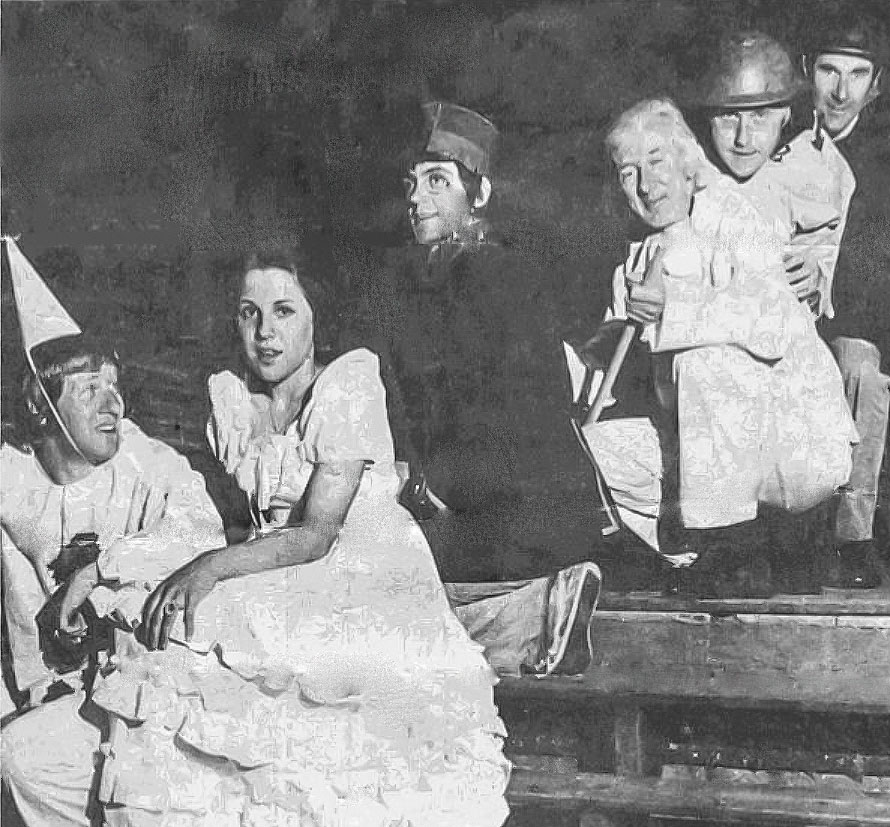
My wife and I lived in Jordans, the historic Quaker Village founded in 1919, on and off for about 18 years through the 70s and 80s. The village was known for three things. The Old Jordans Quaker Meeting House built in 1688; the grave of Sir William Penn, the founder of Pennsylvania; and the 17th Century Mayflower Barn, believed to have been built from the salvaged timbers of the Mayflower, the ship that carried the Pilgrim Fathers to North America in 1620. There was also a locally renowned amateur dramatic group called Jordans Players, of which I was a member. And we were lucky that many, both retired and active, theatre folk lived in the village and were members.
In 1975 the group staged ‘Oh What a Lovely War’ in the Mayflower Barn as a commemorative tribute to the village’s founding ideals (Quaker pacifism, Homes for Heroes, and The Friends Ambulance Unit). The original 1963 stage production, devised through improvisation by Joan Littlewood and her Theatre Workshop, featured a cast of 18 performers who played the 225 individual roles represented in the script. The action, set as a seafront entertainment, alternates between the Home and War Fronts, with actors switching personalities and costumes frequently, playing Pierrots, soldiers, non-combatants, music hall performers and various historical figures (General Haig, the Kaiser, Presidents Wilson and Poincaré and so on).
It was a really fast paced, non-stop scene-changing, somewhat hectic, choreographed production, needing a lot of rehearsal. One would be performing in a scene, then rush off to change costume behind the backdrop often having to join in with the number being sung on stage, then rushing back on again for the next scene, remembering stage movements, snappy one-liner exchanges and longer speeches.
Throughout the play, World War One photos were being shown sequentially on a large screen, each relating to the onstage action, and there was an electronic statistics board constantly being updated with casualty figures – ‘Passchendaele… British Loss 13,000 men in 3 hours… Gain 100 yards…’. The onstage jollity, words and music, clashing with the photos and statistics was deeply disturbing and emotionally moving for the audience.
And the songs change in timbre throughout the show (which runs in chronological order) from jolly music hall, numbers, to jingoistic ‘We don’t want to lose you, but we think you ought to go…’, and later into deeply melancholic songs, the words rewritten by morose, shell-shocked soldiers at the Front, such as, to the tune of ‘What a friend we have in Jesus’ – ‘When this lousy war is over, no more soldiering for me, when I get my civvy clothes on, oh how happy I shall be…’ resoundingly sung a cappella by one of the cast.
In one of my scenes I played a French officer sitting stage right, while Nigel, a retired actor sat stage left dressed as a German officer. The lights dimmed and the theatre hushed; a spotlight shone on me as I read out a genuine WWI letter home. I had a crib sheet for this, so didn’t bother to learn the lines… Then during the dress rehearsal, the director, Deryck Thornley (National Theatre and a Jordans resident) decided it was wrong for me to don my glasses for this scene in place of the fake monocle I used for other French parts. I told him I couldn’t read without my specs. “Then learn the bloody lines,” he insisted in Cecille B. DeMille mode.
I tried but kept forgetting the last few (I had a lot of lines and stage movements to remember). ‘Drying up’ (forgetting your lines), was a terrifying thought, possibly throwing everyone off course (and even ‘breaking the fourth wall’) – a potential disaster for this highly choreographed, non-stop production. I told Nigel how worried I was and he, with all his stage experience said, “Look, whatever you do, don’t panic. If you dry, I’ll count to five, and then start reading my letter… the audience will never notice.’
We got through the Thursday and Friday performances more or less okay – I stumbled a bit and managed to ad-lib the last few lines until Nigel came in. But, when Saturday, the day of the last performance, dawned, I was strangely jittery… not only was the theatre going to be packed, but our local MP, the Mayor and other council dignitaries were going to be there along with the local Press; but worst of all, my boss and his wife were coming… both having Oxford degrees in English Literature. Aagghh!
The moment arrived and I started my piece (in a Franglaise accent), “Zee battlefield is unbelievable; ‘eaps of corpses, French and German, lying everywhere, rifles in ‘and. Thousands of dead lying in rows on top of each uzzair in an ascending arc from zee ‘orizontal to an angle of sixty degrees. Zee guns recoil at each shot; night is falling and they look like old men sticking out zair tongues and spitting out fire. Zee rain has started, shells are bursting and screaming; artillery fire is zee worst. I lay all night listening to zee wounded groaning …” and then I completely blanked, totally unable to recall the last few lines or think of anything to say in their place. So, I remembered Nigel’s ‘don’t panic’ and waited on tenterhooks for him to come in… nothing… the seconds ticked by… still nothing… then I really did start to panic – it was probably only a dozen seconds before Nigel realised and remembered what we’d arranged, but it felt like an hour to me sitting on stage under a spotlight, frozen and completely dumb in front of a large, expectant audience… I was mortified, but had to get over it and press on, we were only a third way through the play.
The rest went off pretty well and we had several curtain calls and a standing ovation. After, my boss and his wife came up to me and said they thought it was a really good production, but the bit they thought was outstanding was the long dramatic pause after I’d read out my letter. “That worked brilliantly,” they said. “Really captured and enforced the deep emotion. Theatrical magic!”
I never told them the truth of course, but to this day I am grateful for Nigel’s “Whatever you do, don’t panic,” which got me through many a Jordans Players performance over the following dozen years.