
SUBUD WRITERS CLUB MEMBERS
Marcus Bolt

And That’s When I Knew …
I was seventeen and two terms into the Lower Sixth year, studying A-level Art, French and English. Literature with a vague idea of perhaps going to Uni; but, having become obsessed with motorbikes, decided to leave school, get a job and buy one.
After a couple of years working in factories and on building sites, through my girlfriend’s father, who was a Governor at the local Secondary School, I got a post as an unqualified teacher. While there, I was taken under the wing of the art master – who convinced me I had talent and told me I definitely should go to art school. But to get a grant and a place on a Foundation Course, I needed A-level Art, which I managed to pass thanks to the local Further Education College’s night classes. I applied for and secured a full grant and then a place at St Albans Art School (now part of the University of Herts).
Walking into the college building on that first day felt like a homecoming. I loved the cultural kudos of being at art school and the sense of freedom being a student gave me after three years of mundane employment. I revelled in the work, both practical and theoretical, as well as the interaction with fellow students and our lecturers. This Foundation Year was exceptionally well run, and I shall never forget the trips to the Reading Room at the British Museum where we students were allowed to actually handle and study drawings by the greats. I remember holding in my hands such sublime things as a silver point drawing by Leonardo da Vinci, through to a shopping list written by Reynolds, the latter making me realise people from the past were just like us – a revelation in those hungry-for-knowledge days.
I also enjoyed the friends I made and, because of a new-found talent for organising dances and entertainments, felt valued and popular. I went to lots of parties and got drunk often. The lifestyle fitted me like a wetsuit and, in common with the Charles Ryder character in Waugh’s Brideshead Revisited, I too was ‘drowning in honey’.
It was all such fun, but at the same time, hard work and a steep learning curve for me. One time, after a college trip to the Victoria and Albert Museum, we were tasked with writing an essay on the differences between Michelangelo’s and Donatello’s ‘David’.
At the V&A, there are a full size plaster casts of both the Michelangelo version – the original carved from a block of Carrera marble, and the Donatello ‘David’, originally modelled in clay, then cast in bronze. The originals of both sculptures are housed in Florence.
Michelangelo’s piece presents an athletic young man in a kind of he-man pose, naked with a slingshot over his left shoulder, and is 5.17 metres tall (approx. 17 feet). Donatello’s shows a young, willowy shepherd boy clothed in a tunic and holding a sword in his right hand with his left foot on the severed head of the giant Goliath; this full size plaster cast is 1.265 metres in height (approx. 4 feet).
So, off I went and wrote an essay based on the theme of my preference for Michelangelo’s version, because, I wrote, he was obviously a well-muscled strongman, and you’d have to be a very confident, very macho tough guy to defeat a giant warrior and so on. And, by contrast, asked how could Donatello’s twelve-year old, somewhat puny boy pull off such a feat?
A week later, during a one-to-one tutorial on my essay, my tutor, Anthony Harris, the college principal, quietly said to me, “Yes, but what about divine intervention? And doesn’t a youthful, weak body pitted against a giant mercenary reinforce the concept of a miraculous event? And that the underlying message in the David and Goliath story is, perhaps, that faith overcomes the ‘giants’ of fear, depression and other problems in our life?”
His gentle, questioning statements were, to my mind, like the floodlights at a football stadium switching on section by section, slowly revealing the pitch…
And that’s when I knew… I wasn’t as clever as I thought. I hadn’t got it; I’d completely missed the point – and that intellectually, culturally, historically I had a lot to learn… then further shocked to realise that even geniuses like Michelangelo can get it so wrong – probably due to his penchant for athletic male bodies.
It was, in many ways, an epiphany, which set me off on a lifelong quest to try to really understand the underlying meaning and symbolism concealed in cultural artefacts – paintings, sculptures, films, books, poetry and music.
When the Foundation year ended, I left St Albans Art School and started a degree course at Maidstone College of Art (now part of the University of Kent). The modules on the three-year course included graphic design, photography, typography and the history of art. I found the latter the most challenging, because it made me think deeper, study harder and, ever since, to always strive to go beyond the obvious, to go deeper. And for that, I am grateful to my laid back St Albans tutor.
By Marcus Bolt
For Once In My Life …
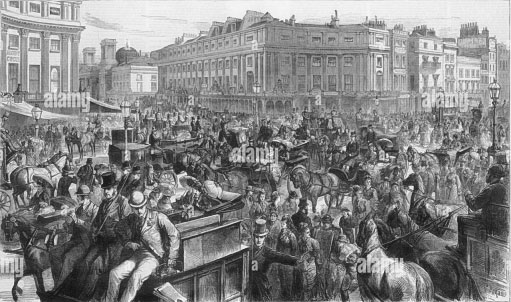
Oxford Street, August 1869… a noisy, bustling formicary of fashionable shoppers, hawkers, tradesmen, messengers, sandwich boarders, nannies with children in prams, horse drawn cabs and coaches – and pickpockets, prostitutes, grifters and handbill distributors, all going about their business.
One of the latter, a Mr. Timothy Leonard, is being tailed by a plain-clothes member of the recently formed Metropolitan Police. Having accepted and read one of his proffered handbills, the detective, Sergeant Martin, has decided they are indecent. He follows Leonard and observes him enter the premises of Dr. Gilbert Du Brange in Gilbert Street, off Oxford Street, London West One.
Later, after further investigation, Du Brange is arrested and charged with ‘paying for the distribution of handbills of a character not sanctioned by the Commissioner of Police’ and ‘fraudently advertising himself as a member of The Royal College of Surgeons’. He is then summoned to appear before Marlborough Magistrates Court in October 1869.
From The Times, October 1869:
Sergeant Martin told the court that the indecent bills in question were adverts for medicines claimed to cure the pox, other sexual diseases, impotence and abortion remedies for women. He also told the court that on entering Du Brange’s premises, he observed it had the appearance of a doctor’s shop. A diploma in the name of Dr. Gilbert Du Brange was displayed in the window and ‘Dr. Du Brange’ was written on a sign on the door. He witnessed Du Brange making up medicines and selling them. He also saw what he called ‘several disgusting medical representations’ pinned to the shop walls.
When questioned by the magistrate, Du Brange said he was well known and highly respected and that he had been selling pills in the open air for about two or three years until about nine months ago when his business had increased so that he now had to stay in his shop and employ handbill distributors. When he sold a box of pills, he said, he wrapped them in a handbill to advertise his products. When he sold them to a woman, he wrapped them in plain paper. He told the court that he sold about three or four gross of pills every day and that they were very popular and highly efficacious.
He then stated that in order for him to be convicted of the offences, the court must prove he was an annoyance to those seeking medical assistance and the public in general.
The magistrate replied that nothing of the sort was required. Du Brange then, turning in the dock, repeated directly back to him that it was indeed most necessary. The magistrate replied that Du Brange’s manner was in the highest degree offensive and ungentlemanly, and that he had better conduct himself properly.
Du Brange continued to argue his case, stating his pills were ‘effective and necessary’ until being forcibly removed from the courtroom on the magistrate’s order.
Du Brange, born as Gilbert Tiffin, may have continued to sell his pills, but changed his name yet again, this time to Greenwood (adopting the name of his wife) and may have moved to Derbyshire. There is no further record of him except on the marriage certificate of one of his sons (dated 1891), where his name is registered as ‘Gilbert Tiffin Greenwood’, and his occupation is recorded as ‘Herblist’.
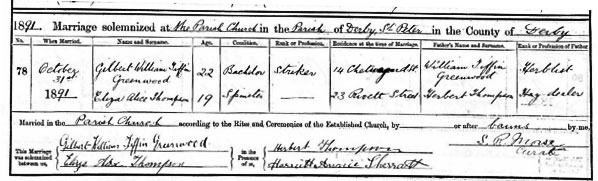
His son, Gilbert William Tiffin Greenwood, a blacksmith’s assistant (or striker), living in Derbyshire, had a daughter called Gertrude. She later met and married a Canadian immigrant called William Cousins (originally Cozenz, but changed during the First World War for fear of being thought a German). The couple had two sons, Gilbert and William, and two daughters, Alice and Florence. Alice married Frederick Bolt in 1940, and they had two sons, Brian and Phillip. Brian changed his forename to Marcus in 1970.
Yep! Dr. Du Brange is, in fact, my great-great-grandfather.
NB: This story is 98% true, but in docudrama style I have conflated several Du Brange court cases and Times reports to simplify the legal complexities, but have retained the essence. It is reported that Du Brange said, “This will break me!”, but to include the prompt line, I have ‘put words in Du Brange’s mouth’. Please forgive the contrivance.
By Marcus Bolt
Just Another Ordinary Day
Right… just had voice recognition software installed… let’s try it out.
I always wanted to be a writer. English was my best subject at school, and I read English Lit at Uni. But, after an average degree, couldn’t get work in the media, and I had to find a way to pay London rent and eat… best I could do was mind numbing work at McDonalds… which meant I was always too tired at the end of the day to write. And on my one day off, had to shop, do laundry, sleep, see friends… get drunk… So, after a dozen failed starts on my Pulitzer Prize winning novel, I sort of gave up…
And then – three years ago – I won two hundred and ten million pounds on Euromillions…
Life was pretty hectic for a while then. Investors, accountants, the media, charities all harassing me non-stop. Not forgetting the begging letters from my ‘long lost family’ demanding financial help. I had to get away from this madness and found a company that helped me buy an island in the Caribbean for about half my fortune, and to invest the rest so I had a fat income for life.
Now, I thought, at last I’m free to write. It was de l’Isle-Adam who wrote in his play, Axël, “As for living, our servants will do that for us”. And the island came fully kitted out with a billionaire’s all mod cons house and servants aplenty to handle all that day-to-day living stuff.
So, I’ve been here, supposedly living my dream for the last couple of years – but haven’t written a single word.
Instead, I wake up around 7am to a knock on the door as my breakfast is delivered. The sun and a light perfumed breeze pour in through the open sliding glass walls and I sit up in bed drinking fresh brewed coffee with croissants while gazing out at the azure sea, waving palm trees and bushes of purple-pink and yellow flowers which are everywhere. The Caribbean has a tropical climate, usually around 30C most of the year; the expansive sky is an intense blue with vivid dawns and garish sunsets. We have occasional showers and sometimes dramatic tropical storms, and the sea is warm enough to swim all year. But now, it doesn’t really do anything for me any more…
Eventually, I get up, slip on trunks and flip-flops and wander down to the beach for a morning swim, preferring the sea to the house’s pool. After, I shower and change into T-shirt and cut-offs, have a brief chat with the island manager, Tariq, who I know probably rips me off, but I don’t care… I can afford it. He does his job well, handling everything – cleaning and catering staff, ordering supplies, maintaining generators… He sifts through the rare communications, by now knowing what might be of interest to me, or needs my attention – and then asks what I’d like for lunch and dinner… and that’s usually it…
I sit at my desk and have a quick look on Facebook and doom scroll YouTube for a while – internet connection here is expensive but good. Eventually, I force myself to open Word and sit staring at the blank screen, mesmerised by the blinking cursor until my thoughts start saying in synch ‘write’, ‘write’, ‘write’. But I can’t… nothing comes through… any literary thoughts or possible ideas I’ve had suddenly seem banal, clichéd, irrelevant, non-starters. This inner struggle leaves me exhausted, lethargic, as though I’m too hot, despite the air-con working flat out.
So, I shut down and go for a walk on the beach. Sometimes I walk the island’s circumference – tedious, but it helps pass the time.
I return for a light lunch, usually fruit but sometimes a bacon or sausage sandwich – exciting, not – read the day’s newspapers online… but can’t connect, all seeming unreal, alien, nothing to do with me.
After lunch, it’s swim, nap, music, Netflix, boredom, loneliness, depression… Occasionally, I’ve asked Tariq to fly in a girl from the mainland… but by the time they arrive I’ve lost interest; in my case, both spirit and body are weak… I might want to write, but without the stimuli of the world and relationships, there’s nothing there.
In one way I’m like those old 20th century existentialist writers experiencing the living death of ennui, of nothing mattering anymore, nihilism they call it; but, it’s so deep in me that, unlike Sartre and Camus, I can’t even write about it.
I’m stuck in a suffocating, luxurious rut, a prisoner of my own lethargy… and wealth; and I can’t break free, every day becoming just another ordinary day. Perhaps it’s time to sell up and go home, but, frankly, I can’t be arsed.
Huh! Just read that back… Voice to text doesn’t make me any more creative, I see. I’ve still got nothing to say… Now, where’s the ‘delete’ button…?
By Marcus Bolt
Whether…Weather
North London, 1945. The war has just ended, people are out celebrating in the streets, in public spaces, in the pubs. They are now filled with hope for the first time in a long time, excited for the future.
In a North London pub, the moment Florence first sees John, she is smitten. He’s with a group, laughing, joking, drinking. To her, he seems like a film star, a man of the world, handsome, charismatic.
She is nineteen years old and knows men are attracted to her by the head turnings and wolf whistles she gets. She is always as fashionably dressed as possible, despite wartime austerity. She wanders over towards the group, hoping to get noticed. John, eleven years her senior, spots her immediately, puts an arm around her shoulders and pulls her into the group, asking if she’d like a drink. He then goes into full chat-up mode… and that night, their relationship begins.
Fast forward to a dreary 1948. Rationing, unemployment, stagnation, the whole country suffering economically and emotionally after the horrors and cost of surviving a World War.
Florence fell pregnant soon after meeting John, and they are now married and living in N19. She has a two-year old son, Gerry, and a nine-month old daughter, Jean. The couple are struggling, virtually living in poverty. John is still womanising, but says he loves her. Florence still idolises him.
And then came the shock. A woman turns up at their flat in Wedmore Gardens accompanied by the police. It is John’s legal wife, who has had two sons by him… he is a bigamist.
John is charged and a trial date set a few months ahead. John has decided to go back to his wife in Cleethorpes for a while to try to smooth things over, taking the new son with him and leaving Florence with the baby.
She is heartbroken, traumatised. She has no support; can’t get work with a 9-month old baby and is still suffering postpartum depression. Overwhelmed by grief, carrying the baby in her arms, she walks out… First she crosses Holloway Road and walks down Marlborough Road, where her older sister, Alice, lives with her husband and their two boys. Florence begs Alice for help, but her sister, always judgemental and somewhat sanctimonious, reacts probably like most would have in those days.
“I’ve always been suspicious of that man. He wasn’t right… and you was such a floosie, droppin ’yer knickers like that. Well, I’m not gonna ‘elp you… you made yer bed, you go lie on it.”
Devastated, Florence continues up Holloway Road, still carrying the baby. A few streets up she turns into St John’s Villas, where her parents live, with her brother, Bill, and his wife. There she has virtually the same reaction, and is turned away. Sobbing, feeling rejected by her family, she continues up Holloway Road. She doesn’t know what to do. Her world has collapsed and nobody will help her. She was naïve, knew nothing of Social Services, which were in their infancy in 1948. She’s missing her son and is longing for John’s love, now aware she can never be with him again, that it’s over.
Feeling wretched, alone, distressed, not knowing whether she can weather this storm, she realises she is unable to look after her baby, and that there is only one solution.
She turns down Giesbach Road and walks until she comes across a warmly lit terraced house. Through the downstairs window, she sees its occupants having supper. She lays the baby gently on the doorstep and quickly walks away, sobbing, praying that the baby will soon be found and looked after.
Florence retraces her steps, turns right out of Giesbach Road, crosses the busy junction and walks up Archway Road to the huge arch that spans it… She climbs the steps, stands by the railings and looks down on the traffic 65 feet below…
******
This story is only partly true, based on ‘my best guess assumptions’ in docudrama style, using the known facts from newspaper reports, court documentation, adoption papers, birth, death, marriage certificates and the memories of those few of us who were involved at the time and still alive today.
The Archway Bridge, finished in 1900, has been colloquially called ‘The Suicide Bridge ’ever since, with three or four suicides a year, even today.
If Florence did go there, she didn’t jump. As the months went by, the children were forcibly taken into care and hurriedly adopted under new rules (the Children’s Act 1948). John went to prison for six months for his bigamy. Florence didn’t go to jail, but was put on a year’s probation for abandoning her child, the magistrates being lenient, understanding the emotional stress she was under. And she did weather the storm. She soon met another man, called Dennis Branch, and was quickly impregnated again with another son, Derek (who committed suicide when an adult). She and Dennis married and later had two daughters.
Florence was my mum’s sister, my Auntie Flo (the Dr. Du Brange I wrote about last time is her Great Grandfather). I adored her when I was about four, a few years before this tragedy unfolded; I remember her as funny, warm, full of life – and I think she had a soft spot for me too.
The impressive genealogical digging my newly found second cousin has done (including talking with one of John’s sons from his first marriage) reveals that Florence did meet up with John again, in Cleethorpes; the son remembers her, but we have no idea why she went or what transpired. There is a definite possibility that John and Florence were deeply in love, that the tragedy of their relationship has an ‘End of the Affair’ nuance. But, from all reports it seems John was a narcissist, causing much hurt and damage to his family with his comings and goings (leaving the family saying that he was in the army; but his name appears in no army records). His lies and subterfuges, and his many, many affairs, wreaked havoc wherever he went. His son claims he was also physically abusive to his wife and children and obviously detests even the memory of him. But perhaps John did love Florence and just made a foolish decision, hoping he could get away with the deception. We’ll never really know now.
Abandoning a baby would be an unforgiveable sin in today’s society, but, historically, child abandonment by mothers was distressingly common, particularly among impoverished or unmarried women facing severe social stigma and lack of financial support. Driven by desperation rather than a lack of maternal love, many mothers left their babies at foundling hospitals or in public spaces hoping they would be found and cared for.
I was saddened by these revelations, but the thing my second cousin uncovered that really got to me emotionally was that, although Aunt Flo’s legal, registered name was Mrs. Florence Mamie Branch, on her gravestone – and apparently this was her dying wish – the name reads Florence Jean Branch. Jean was the name of the daughter she abandoned.
She had carried a lifelong love (and probably guilt) for her daughter to the grave.
By Marcus Bolt