Iljas Baker
Iljas Baker
 Author’s Statement
My favourite poetry has always been that of the East Asian poets that I have read in translation, especially Han Shan, Basho and Ryokan. I have admired it chiefly for its brevity, its sensitivity to nature and its mindfulness of the fragility and transience of life. I was drawn to this poetry during a period of my life in my twenties when I left behind the counter-culture and its dubious pleasures and became a Buddhist. I drew on these styles to publish poetry in a chapbook and broadsheets while I was a student. After graduating there was a long hiatus when I did not write any poetry. Nevertheless, I retained a strong feeling for this Taoist and Buddhist poetry even after I converted to Islam over 40 years ago. After the end of Ramadhan a few years ago I felt moved to write a poem loosely based on the Chinese and Japanese poems I had been reading in translation but expressing the distinct worldview of Islam. I was quite pleased with the result and have continued to write in this manner as well as writing various free-verse poems reflecting an Islamic worldview and Islamic themes.
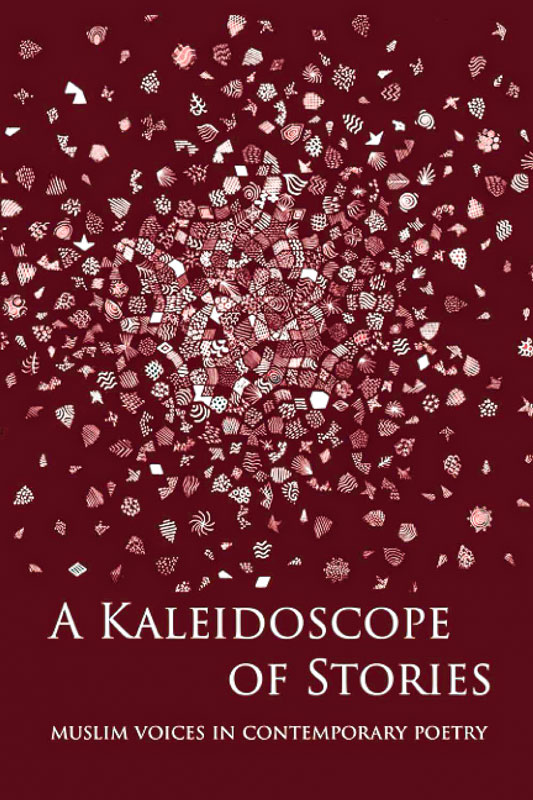
I felt strongly that the only way to improve as a poet was to try to submit my poems to poetry journals. Before doing this I usually sat down with my poems and reread them numerous times until I could feel what was not quite right about them and to make appropriate changes before sending the poems off. Many of the poems I submitted were accepted for publication in journals mostly in the USA and Türkiye and also in the 2020 anthology A Kaleidoscope of Stories: Muslim Voices in Contemporary Poetry published in Cambridge, UK as well as Subud anthologies.
If I was to characterize my poetry I would say it is predominantly about essential things.
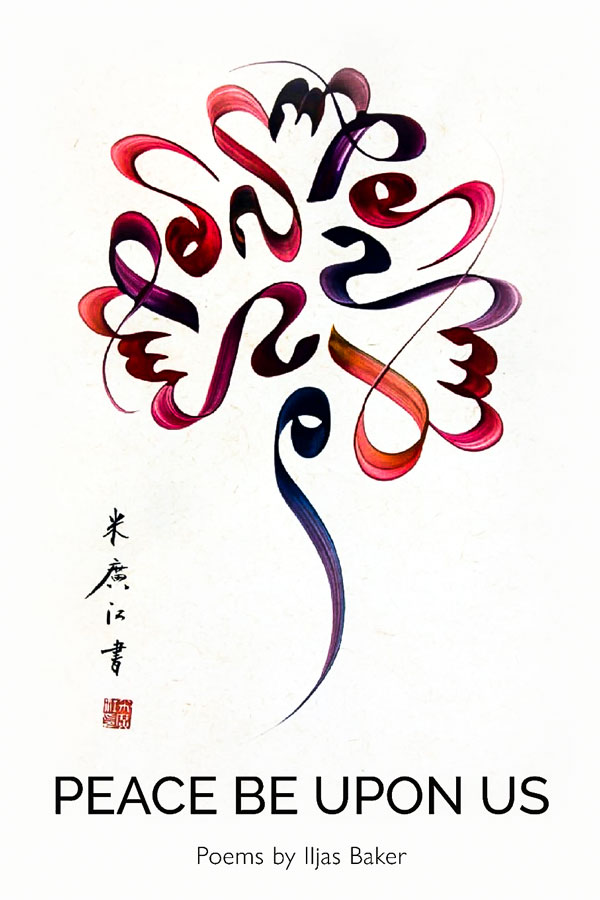
Peace Be Upon Us – Anthology of Poems
In this sublime book Iljas Baker gives us a glimpse-in poetic form-of his spiritual journey through Buddhism, the spiritual exercise of Subud, and Islam. Many of the poems use Chinese and Japanese poetical forms, especially Haiku, Haibun and Tanka, but express somewhat uniquely an Islamic rather than a Buddhist worldview. The presence of some examples of the world-famous calligrapher Haji Noor Deen’s Chinese interpretations of Islamic calligraphy adds a beautiful and complementary graphic element to the subtle marriage of East Asian literary forms and Islamic spirit to be found in this book.
Iljas’s poems and poetic artistry demonstrate the universality of Truth which, being Absolute, can and must manifest in every culture and in every art form, and both penetrate and embrace human life from the most mundane to the most exalted.
-Imam Feisal Abdul Rauf, Founder and President of Cordoba House
VEILS
on a late evening walk
to still
the wheel of thought
the sweet spicy scent
of tree jasmine
the sound of
water falling
a bright crescent moon
and a shining star
are all laid out before me
and behind these wondrous veils
are the many Names of God
What Shaped Her
Frances in her library
reading a book on Hamada
in the studio
the potter’s wheel
turns and Frances turns
anew
she repairs a broken bowl
the golden seams
she said
make the repaired
more beautiful than the whole
on the table
are the flowers she planted
then tended
then cut
and brought indoors
to arrange
just so!
her bees gift her honey
which sweetens our world
we ate some the last time we met
while talking about
the poetics of Bashō
the tea ceremony
and her young brother’s death
long ago
that shaped her
A KALEIDOSCOPE OF STORIES
The poets appearing in this anthology are seekers, teachers, artists, parents, activists and much more. From every continent and spanning generations, their collective experiences appear in verses of love, devotion, grief and healing, as they take us on a journey through cityscapes and the natural beauty of the world we live in. Through their insights and inspirations we find ourselves in London, New York, Istanbul, Fez, Damascus and Makka, in mosques and at sacred sites, in deserts, mountains, and under towering redwoods, in heart-opening moments of connection. Their poetry navigates all the seasons of life, reflecting and meditating through their outward and inward pilgrimages upon our relationships to those around us and to the Divine.
A KALEIDOSCOPE OF STORIES – Muslim Voices in Contemporary Poetry brings together the myriad voices of eighty Muslim poets from diverse backgrounds to powerfully articulate what it means to be Muslim in the modern world. It provides a platform for Muslim voices to be heard speaking about their experiences in their own words, and offers an antidote to the stereotyped, one-dimensional portrayal of Muslims we see so often in the media.
The anthology gives the reader a glimpse of the thoughts, hopes and challenges of those who see the world through two or more cultural lenses, and provides an authentically Muslim space for the expression of our spiritual, social and personal lives. It brings together the verses of multi-generational voices exploring themes including love and loss, identity and belonging and Islamic spirituality.
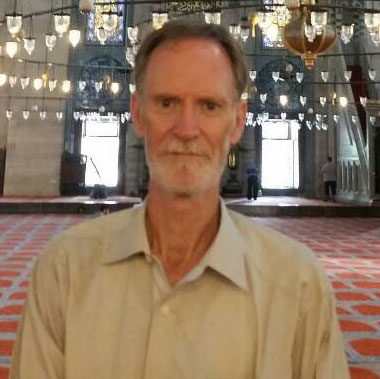
Iljas Baker is a retired university professor born in Scotland and living in Thailand. His debut collection Peace Be Upon Us was published earlier this year by Lote Tree Press, Cambridge UK. He has been published in a number of anthologies, the latest being Kaleidoscope of Stories: Muslim Voices in Contemporary Poetry and has been published in various journals in Asia, the USA and Europe.
- A number of Iljas Baker’s poems have been included in Kosmos: Journal for Global Transformation. The Journal mainly focuses on humanistic education, new societies, compassionate politics and spirituality. It publishes few poems throughout the year but each year there is an edition devoted to poetry. Iljas’s poems appear in the annual poetry edition, which this year is the 15 January 2024 edition titled Kosmos Poetry. The Art of Letting Go. The organization that produces the journal has consultative status with the United Nations. The poems can be read at: https://www.kosmosjournal.org/news/kosmos-poetry-letting-go
- Those of you who subscribe to Amethyst Review will have received Iljas’s most recently published poem in their inbox, but if you’re not a subscriber you can go to the journal via this link and read the poem there. It is called What Shaped Her. https://amethystmagazine.org/2024/03/06/what-shaped-her-a-poem-by-iljas-baker/