
Delia’s Geometric Glasswork
Delia Whitbread is a painter as well as a stained glass designer and maker. She works in a variety of media from charcoal, through gouache to oils. In 1985 she undertook the Mural Design Course at Chelsea School of Art where she specialised in stained glass. She went on to study Visual Islamic and Traditional Art at the Royal College of Art and completed an MA by Project in 1989. She was a Senior Lecturer specialising in the teaching of stained glass in architectural context for the Art in Community course at the University of Surrey, Roehampton for the 14 years. In 2008 Delia completed an art-practice-based PhD in the School of Art, Design, Media and Culture at the University of Sunderland — the culmination of a 20 year dream to make a rose window celebrating multi-cultural female images.
Commentary on the Works
View the gallery (or in a separate tab)
Blue Snake (1999)
Sample tracery panel for the finished digital image of Lilith – in the Heroines section of The Womb of the Rose digital rose window project.
Size: 56 cm x 42 cm; Frame: Framed with fixings for hanging;
Medium: Leaded glass panel with stained, etched, sandblasted, enamelled and painted details.
Cornish Sunrise (2010)
A decorative piece based on a Cornish seascape using a mosaic of clear unfired glass polished and fixed to a clear glass panel with clear adhesive.
Size: 35 cm x 35 cm; Frame: Lead framed with soldered copper wire hangers for fixing;
Medium: Appliqué glass panel.
Cosmic Egg (2002)
Third sample panel made for the central panel of The Womb of the Rose digital rose window project. It is based on the Hindu image of the Tantric Egg matter before it becomes form floating in chaos. In the design it symbolises the essential transgendered nature of all matter — like the egg in the womb before fertilisation.
Size: 85 cm diameter; Frame: With fixings for hanging;
Medium: Leaded glass panel with stained, etched, sandblasted, enamelled and painted details.
Divine Union
This panel is part of a series illustrating sea symbols and is based on a cockle shell.
Size: 35 cm x 35 cm; Frame: Unframed with soldered copper hangers;
Medium: Leaded glass panel with stained, etched, enamelled and painted details.
Family Myth (2010)
This commissioned panel shows the buyer’s family in an imaginary narrative based on her persona in an online gaming community where she used to be known the Mistress of Thieves. As the buyer lives in Northumberland, it is a coastal scene with Bamburgh Castle in the background. She carries a key and some jewellery taken on her raid to the castle.
Size: 55 cm x 70 cm; Frame: Framed;
Medium: Leaded glass panel with stained, etched, sandblasted, enamelled and painted details.
Kali — Mistress of Life and Death (1989)
The first sample panel made for the central Archetypes section of The Womb of the Rose digital rose window project illustrating the Hindu Goddess Kali. One of oldest of the Hindu deities, she blesses with her right hands — in the upper one she holds a lotus. However she destroys with her left hands where she carrys a bloody axe and a severed head. Respect for her fearsome nature was a mark of devotion among her disciples who would meditate in graveyards to overcome their fear of death. She is often shown with a black face to symbolise her destructive energy but her white face symbolizes liberation. The small pattern panel below the main image features the geometric symbol for Kali in the Hindu tradition – a downward pointing triangle symbolizing her power over the material world.
Size: 120 cm x 200 cm; Frame: Framed, requires fixings for hanging;
Medium: Leaded glass panel with stained, etched, sandblasted, enamelled and painted details.
Lilith 2 – Spirit of Instinctual Wisdom (1998)
Second sample panel made for the middle Heroines section of The Womb of the Rose digital rose window project including two attendant owls who symbolize the all-seeing and wise nature of the goddess. The smaller lower panel contains an 8 petal flower and eye motif.
Size: 150 cm x 180 cm; Frame: Framed;
Medium: Leaded glass panel with stained, etched, sandblasted, enamelled and painted details.
Lilith 1 — Spirit of Instinctual desire (1998)
This panel is based on a 4000 year old clay relief of a Sumerian goddess which is in the British Museum. Innana/Ishtar was the Goddess of Love and War shown riding on lions with clawed feet and wings. She wears a horned head-dress and carries symbols of power in her hands. Lilith was the demonised first wife of Adam — a myth made up long after the original Bible story of Adam and Eve when the Israelites were captives in Babylon. She was reputed to kill babies and haunt men in their sleep.
Size: 80 cm x 100 cm; Frame: Framed;
Medium: Leaded glass panel with stained, etched, enamelled and painted details.
Mermaids and Minotaurs (1995)
This is a Yin-Yang allegory about the relationship of instinct – cold but seductive (represented by the Mermaid), with desire — hot and dangerous (represented by the Minotaur). The story reads from the inside to the border. The Minotaur is kissed by the Mermaid and then he chases her around the circle. In the blue corners of the ring they have eyes only for each other but those eyes reflect their mirrored attraction. In the border she catches him with her flower through the ring in his nose.
Size: 74 cm x 75 cm; Frame: Framed;
Medium: Gouache and Mixed Media on paper.
Pisces
One of a series of small panels illustrating star signs. Pisces in medieval imagery was depicted as two fishes attached to each other but swimming in different directions which accounts for their often contradictory moods.
Size: 25 cm x 25 cm; Frame: Unframed with soldered copper hangers;
Medium: Leaded glass panel with stained, sandblasted and painted details.
Reconfiguring the Rose (2004–2006)
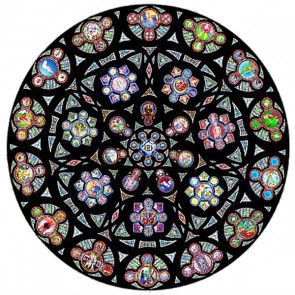
Using the computer to simulate stained glass, a virtual rose window is visualised using modern technology.
The project has produced a unique interpretation of a rose window that celebrates the diverse nature of being female in the 21st century. It adapts the traditional stylization of medieval glass and combines it with multicultural images from all over the world, using the internet to create an online collaboration between the female artists.
This is a visionary project that can be reproduced and projected in different contexts with a powerful and impressive result.
Size: 450 cm diameter;
Medium: Digital media.
Red Snake (1999)
Alternative red background for the snake in the tracery panel for the finished digital image of “Lilith – in the Heroines” section of The Womb of the Rose digital rose window project.
Size: 35 cm x 25 cm; Frame: Framed with fixings for hanging;
Medium: Leaded glass panel with stained, etched, sandblasted, enameled and painted details.
The Big Bang – top section (1987)
This piece illustrates part of a larger design showing the human world in modern chaos – the top section, In the Beginning… shows God’s fragmented creation with saints, birds and an apple tree. The lower panels show a green Devil with a computer surrounded by planes, bombs and bags of money with the rest of the quotation ‘was the Word…’.
Size: 65 cm x 75 cm; Frame: Framed (dark grey painted wood frame);
Medium: Leaded glass panel with stained, etched, enamelled and painted details.
Tribute to Tarkovsky (1988)
Finished panel illustrating some of the imagery common to all the 7 films made by Andrei Tarkovsky, the Russian film Director who died in 1986. The names of the films feature in the red flowers in the tree. The image was largely inspired by his last film, The Sacrifice. The icon recurring in the picture is The Holy Trinity by Andrei Rublev, the 15th century Russian painter, who was the eponymous subject of Tarkovsky’s most celebrated film. The poetry is by his father Arseniy Tarkovsky — a well known lyric poet. The Russian text in the tree translates as ‘But there has to be more’. The translated verse is from the poem “Life, Life”.
Size: 155 cm x 155 cm; Frame: Metal frame;
Medium: Leaded glass panel with stained, etched, sandblasted, enamelled and painted detail.
Tribute to Tarkovsky sample panel (1986)
The sample panel for a larger design based on the films of the Russian film Director Andre Tarkovsky (1932– 1986). The text, taken from one of his father Arseniy’s poems, reads “Reality and light exist, but neither death nor darkness…”
Size: 70 cm x 70 cm; Frame: Framed (dark grey painted wood frame);
Medium: Leaded + Appliqué glass panel with stained, etched, sandblasted and painted details.